Do You Really Need AI Inventory Forecasting?
TL;DR: If your Shopify store is simple, keep your forecasting simple. If your business is genuinely complex — thousands of SKUs, heavy seasonality, marketing campaigns that swing demand — then it’s worth testing AI tools. But most small and mid-size stores don’t need AI to get forecasting right. They need a tool that works, a process they’ll stick with, and good data.
We’re all using AI to improve our daily life and work, so the benefits are obvious. It’s natural to ask whether inventory forecasting for your Shopify store can benefit from AI too.
The problem is, a lot of Shopify apps and software have simply slapped the “AI” label onto features that existed before. It’s become a marketing checkbox. In this article I’ll help you separate the real benefits from the noise.
Let’s make this decision simple right here:
If your Shopify store is simple, then keep your forecasting simple.
If your business is complex, then consider testing AI tools.
What Do I Mean by “Simple Shopify Store”?
If you’re a store with a small number of SKUs, your products have steady demand, demand spikes are manageable, and your team is either a solo founder or a small crew with limited bandwidth — simple inventory forecasting is your best fit. It’ll do the job so you can focus on growing your business.
A tool like IFH (Inventory Forecasting Hero) exists for exactly this situation. It looks at your sales history, calculates what needs reordering, integrates with Shopify Purchase Orders, and gets out of your way. No AI models to train. No dashboards to configure. You check your restock report, place your orders, and move on.
But say your business has thousands of SKUs. There’s a ton of seasonality across them. You need to integrate with your marketing team’s campaigns on social media. External factors like interest rates or tariffs impact your purchasing decisions. You have dedicated staff with time to cross-check everything AI is telling you. At that stage, you probably need a dedicated inventory planner on your team to manage the complexity — and an AI-powered tool might genuinely help them do their job better.
What Do These AI Tools Actually Do?
When apps talk about “AI,” they’re usually referring to two categories:
1. AI for gathering information — ask a chatbot to generate custom reports, pull insights from multiple variables, run quick checks across your catalog.
2. AI for reorder recommendations — factoring in seasonality, marketing campaigns, trend shifts, and other signals to recommend how much to order and when.
Both can be useful. The question is whether your business is complex enough to need them.
Don’t Get Distracted by Shiny Demos
As a merchant, don’t lose track of what you actually care about when you’re evaluating these tools. AI demos can show a lot of “Wow!” moments and “I didn’t know I could do that” magic. But don’t let the magic distract you from what matters to your business and customers:
- Are you running out of stock on your bestsellers?
- Are you sitting on too much inventory that isn’t moving?
- Are you leaving revenue on the table?
- Are you keeping up with what your customers want?
- Are you hitting the goals you set for the year?
If a tool doesn’t move the needle on these things, it doesn’t matter how impressive the demo was.
The “AI Tool” Hiding in Plain Sight
Before you pay for any AI inventory app, try something you already have: Shopify Sidekick.
You can ask Sidekick questions about your store’s inventory and it’ll pull useful answers — which SKUs to focus on based on past sales, how promotions affected demand, what’s trending up or down. If you’ve connected your analytics and sales channels to Shopify, that data is already there.
Sidekick can also pull data from other apps you’ve installed — discounts, upsells, bundles — and help you make sense of it without switching tools.
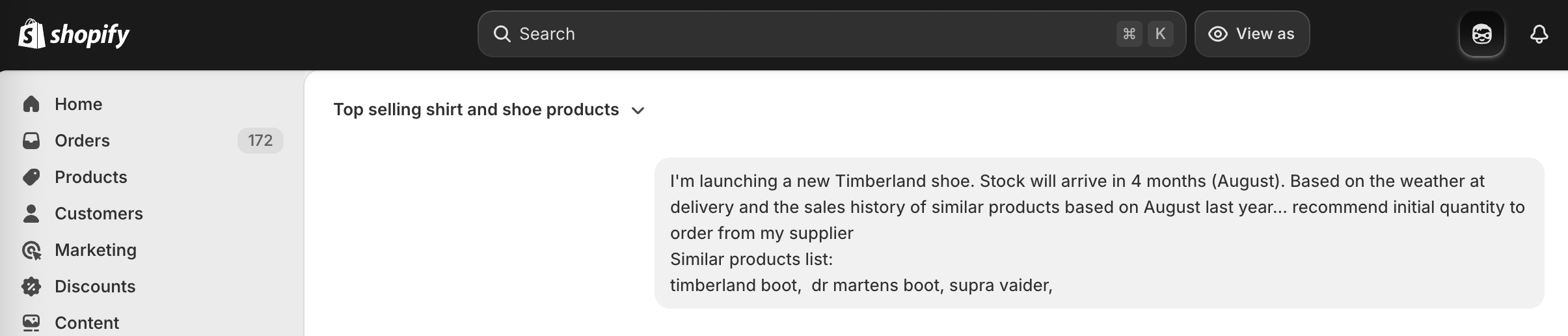
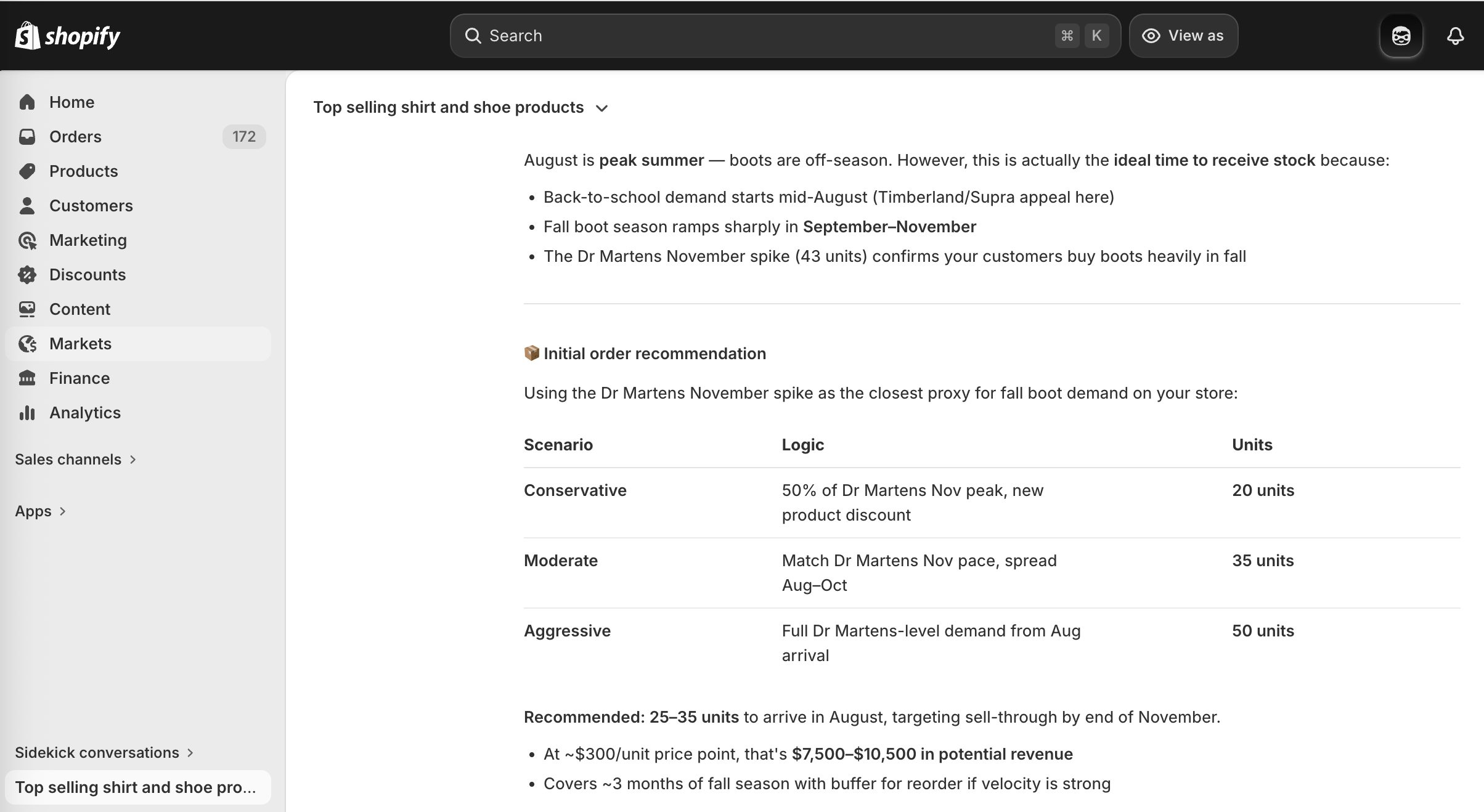
Bottomline: Any paid AI tool has to provide more value than what Sidekick already gives you for free.
Where AI Forecasting Actually Helps
There are some genuinely good apps that use machine learning in ways that matter. Here’s where AI adds real value that simpler tools can’t match:
New product launches. You have no sales history for a new product. AI models can look at similar products in your catalog (or across their dataset) and estimate initial demand. A simple forecasting tool like IFH works best when you have sales history to work with. For brand new SKUs with zero data, AI has a real edge.
Weather and seasonality. If your products are weather-sensitive (think swimwear, heaters, outdoor gear) and you have hundreds of SKUs with different seasonal curves, AI models can detect and apply seasonal patterns automatically instead of you configuring each one manually.
Marketing campaign effects. If you run frequent promotions, flash sales, or influencer campaigns that cause demand spikes, AI tools can learn how those events affect demand and adjust reorder suggestions accordingly. Without this, you’d need to manually exclude or account for promotional periods in your forecast.
Measuring Forecast Accuracy — Proof Is in the Outcome
Don’t just take the AI tool’s word for it. Two practical ways to verify:
Ask for backtesting. A good AI tool should be able to show you how its predictions would have performed against your actual past sales. If they can’t show you this, that’s a red flag.
Run an A/B test. Let the AI tool handle reorder recommendations for one group of SKUs. Handle a similar group yourself the way you normally do. After a few months, compare: which group had fewer stockouts? Which had less overstock? Which was more accurate? Let the numbers decide.
How to Tell If AI Is Actually Worth It
Here’s a stat that should make you pause:
It takes the average business two to four years to see a return on their investment in AI. Just 6% of brands see payback within a year.
Think about what that means in practice. You spend a year integrating a new AI tool, correcting its mistakes, validating its output — only to see a questionable 1-2% boost to your bottom line.
And the cost goes beyond the subscription fee. What about your time? Your team’s time? The ongoing effort of validation, correction, and understanding what the tool is actually doing?
Shopify published a useful article on measuring AI ROI in February 2026 that’s worth reading.
Here’s my take on how to measure it:
Pick one primary KPI and one secondary KPI. Look for a 10X improvement.
Anything less than 10X is hard to measure once you account for the integration effort, the learning curve, and the ongoing overhead. Even tools promising a 20% improvement are hard to validate when you factor in everything it took to get there.
Think about it this way: ChatGPT was 10X better than searching Google for answers. You used to open ten tabs and piece together an answer yourself. ChatGPT just gave you the answer. The improvement was obvious to anyone who tried it.
The question is: are these AI inventory tools 10X better than what you’re already using?
“Only when your product is 10x better can you offer the customer transparent superiority.”
— Peter Thiel, Zero to One
Example KPIs to track:
- Time saved — your team was spending 1 hour a day on reorder planning. Now it’s 1 hour a week.
- Stockouts prevented — stockout rate dropped by 90%.
- Revenue opportunities surfaced — the tool identified bundling options based on seasonal patterns you didn’t notice.
- Layering that wasn’t possible before — you can now factor marketing campaign schedules into inventory decisions.
If the improvement isn’t obvious, it probably isn’t there.
Where We Stand
I want to be upfront about something. IFH is not an AI-powered app today. We’re a simple, accurate forecasting tool built for Shopify merchants who want to replace spreadsheets and stop stockouts — without the complexity.
That said, we’re not anti-AI. We use AI ourselves every day to build features in months that would have taken us a year. And we’ll be adding AI capabilities to IFH in the future where they genuinely help our merchants.
But right now, most of the stores that come to us don’t need AI. They need a tool that tells them what to reorder, how much, and when — and lets them place a purchase order through Shopify without jumping through hoops. That’s what we focus on.
This article is here to help you figure out if you’re the exception.
Key points to take with you:
- Does your business actually need this level of complexity?
- Do you have the bandwidth to manage it on a regular basis?
- Is the AI tool 10X better than what you already have — your current forecasting app, Sidekick, your own judgment?
- Are the benefits obvious without someone having to explain them to you?
This was written in April 2026. AI is moving fast, and I’ll keep updating this article as the tools get better.
“When the facts change, I change my mind — what do you do, sir?”
— John Maynard Keynes
Further Reading
- AI Demand Forecasting — Shopify Blog
- Measuring AI ROI — Shopify Enterprise Blog
- What Is a Reorder Point and How to Calculate It — IFH Blog
- What Is Safety Stock and Why Your Store Needs It — IFH Blog
FAQ
Does my small Shopify store need AI inventory forecasting? Probably not. If you have a manageable number of SKUs with steady demand and a small team, a simple forecasting tool that uses your sales history will do the job. AI adds value when you have thousands of SKUs, heavy seasonality, or marketing campaigns that create unpredictable demand swings.
What’s the difference between AI forecasting and regular forecasting? Regular forecasting uses your past sales data to project future demand — things like daily sales velocity, lead times, and safety stock buffers. AI forecasting layers on additional signals like seasonality patterns, marketing campaign effects, weather data, and cross-product correlations. The trade-off is more complexity and cost.
How long does it take to see ROI from AI inventory tools? According to Deloitte, the average business takes two to four years to see returns on AI investment. Only 6% see payback within the first year. For most small Shopify stores, simpler tools deliver faster, more measurable results.
Is IFH an AI-powered inventory forecasting app? No. IFH is a straightforward forecasting tool that uses your Shopify sales history to calculate reorder points and quantities. It integrates with Shopify’s native Purchase Orders and tracks incoming inventory automatically. It’s built for merchants who want accuracy and simplicity without the overhead of AI.
How do I test if an AI inventory tool is worth it? Run an A/B test. Let the AI tool handle one group of SKUs and manage a similar group yourself. Compare stockout rates, forecast accuracy, and overstock after a few months. If the difference isn’t obvious, the tool isn’t delivering enough value.
Inventory Forecasting Hero does this automatically for your Shopify store. $25/month with a 30-day free trial.
Start Free Trial →